
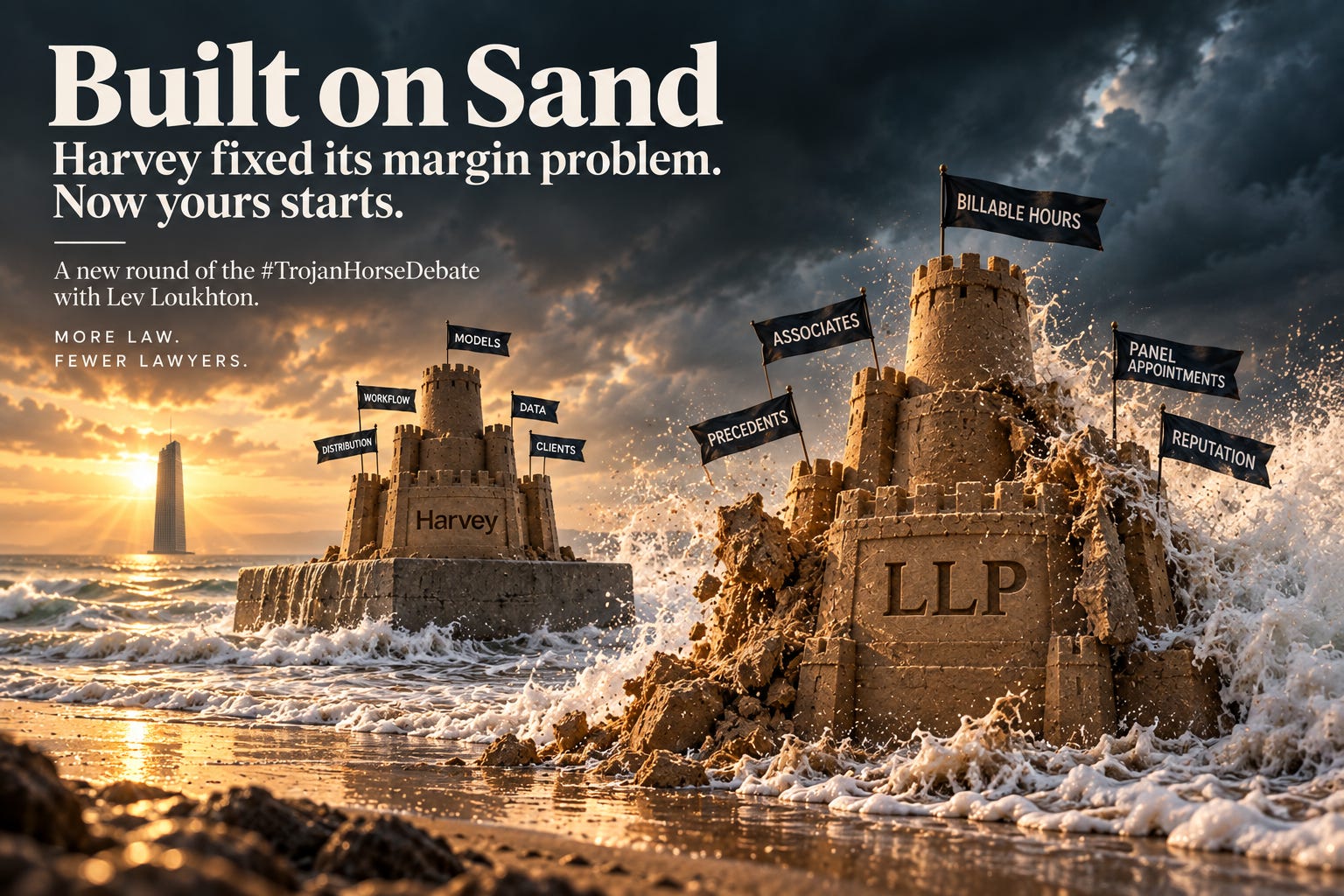
We are witnessing the Trojan Horse rising again - and law firms are giving it a leg up (although not, this time, directly paying for the privilege) - all is explained below.
Mid September 2026. Three things happened in forty-eight hours.
On Monday Bloomberg reported that Harvey, valued at $15.5 billion, had watched its gross margin fall from around positive 50% to around minus 50% between January and June because its customers used the product to increase token usage by 20 times, and that it had responded by moving work off OpenAI and Anthropic and onto an open-weight model it controls.
On Tuesday morning Harvey launched a pro bono programme in the UK, Australia and the US. Harvey says it will build custom AI agents for high-volume casework, including housing support, veterans’ services and social welfare claims, and later this year will pilot free access for a select group of frontline legal services organisations. Access to justice is a societal good and I welcome it. In June, on Bloomberg’s account, Harvey was losing money on every unit of work its customers ran. By September it decides to afford to give the work away.
On Tuesday afternoon Anthropic released Claude Opus 5.5 at a lower price than Opus 5, and roughly ninety minutes later OpenAI released GPT-6 Sol at 50% below GPT-5.6 promotional API pricing and GPT-6 Luna at ten cents per million input tokens, a price below Fireworks’ published Kimi K3 serverless token rates that Harvey had just moved to. I’m wondering how and whether xAI will respond. It may be able to afford more than the others, the question is whether it assesses that it may benefit from doing so.
The token cost rollercoaster may be taking another swing. Harvey climbed off it because the ride had become too expensive. The next day the operators halved the fare. Anyone reading this essay for a settled view of what intelligence costs should stop here, because the honest answer is that the price is set, week by week, by two companies in San Francisco and their competitors in Beijing, and the only stable facts are that it keeps falling but we feel it increasing because as it gets better we use it more.
That instability is the subject. It changes the conclusions of this essay in three ways, which I set out at the end: it confirms that the application layer is dependent on the model companies whichever direction prices move; it narrows the case for owning a model to control rather than cost; and it brings forward the day on which clients buy legal advice alongside the tokens they already pay for. Good Enough is moving up the food chain faster than I expected. I have been warning about it for long enough. Now we can see it emerging.
Last year I argued that the extraordinary valuations attached to legal AI companies were built on sand, and then that the platforms themselves were Trojan Horses. This led to the #TrojanHorseDebate, where Lev Loukhton challenged my arguments head on. The ensuing conversation has engaged some of the most influential leaders in the legal profession, and leaders from consulting, tax and accountancy have joined in, which I have found wonderfully stimulating.
My essays ran two distinct but connected arguments.
The first concerned the technology companies: could businesses valued in the billions remain defensible when much of the intelligence beneath their products belonged to somebody else?
The second concerned their customers: why were law firms enthusiastically adopting platforms which were moving progressively closer to the work those firms were themselves being paid to perform?
Lev disagreed, repeatedly and persuasively.
Harvey and Legora, he argued, were becoming far more than “wrappers” around somebody else’s model. They had workflow, integrations, specialist knowledge, distribution, enterprise relationships, agents and increasingly sophisticated technology of their own. Law firms, or at least lawyers, he argued, retained agency. The profession had adapted to technological change before, and would do so again.
I should open this round with an admission.
Lev was right about some of that, and what Harvey has done since may prove his point better than anything he said.
It also creates a considerably bigger problem for the law firms buying it.
Then Bloomberg published one number…
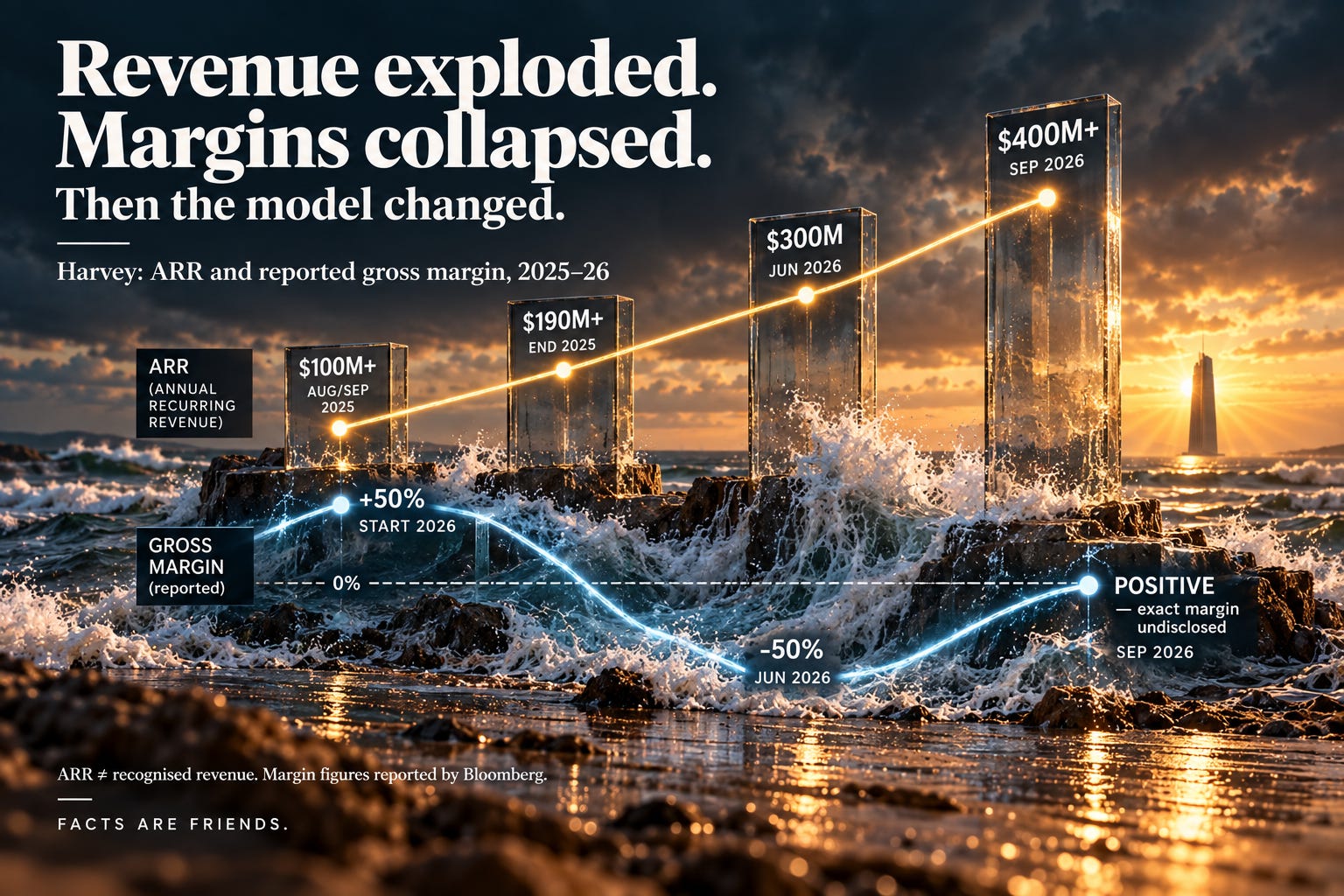
According to a person familiar with Harvey from the inside cited by Bloomberg, Harvey’s gross margin was around 50% at the beginning of this year. By June it had fallen to around minus 50%. Harvey declined to comment on those figures.
The cause is what makes the number interesting.
Harvey’s customers had carried on using the product and had started using it enormously more. Harvey says its AI token consumption has increased twenty-fold this year.
So one of the world’s most valuable legal AI businesses reportedly became gross-margin negative while consumption of its product was exploding. This exposes something fundamentally different about the economics of AI. Traditional software has wonderfully attractive marginal economics: build the product once, sell it repeatedly and another customer’s extra click costs very little. Inference leading to intelligence behaves differently. Harvey was selling “intelligence” which, to a significant degree, it was buying from somebody else. Every additional query, every longer agent run and every additional token carried a cost. The better the product became, the more people used it, and the more they used it, the more intelligence (tokens) Harvey had to buy. The meter kept running. Clients of law firms know that feeling. That was the sand.
I owe Lev (half) a pint when he is next in London
Harvey acted. Over the past six months, it says, its research programme has focused on building legal intelligence using open-weight models and on enabling legal teams to build and own specialised intelligence themselves.
In August it announced Harvey Tenet, its first post-trained open-weight model, based on Moonshot AI’s Kimi K3 and developed with Fireworks for long-horizon legal work.
Fireworks says Tenet completed almost twice as many held-out Legal Agent Benchmark tasks as base Kimi K3 at roughly the same cost per task, with the saving coming from cheaper open-weight inference and from using fewer tokens.
Bloomberg reports that Kimi K3 performs close to Anthropic’s strongest offerings at a fraction of their cost and that, together with other changes, the move has reportedly returned Harvey’s gross margins to positive territory.
I understand this by thinking about televisions. The step from GPT-3.5, the model behind the original ChatGPT, to Astra and Fable was as black and white TV was to 4K (with High Def between them, as there were models in the development of Claude and ChatGPT). The frontier models are now 8K. From the sofa, most of us cannot see the difference between 4K and 8K, and we certainly will not pay double for it. Open-weight models are now 4K. Most people buying legal services as sitting on the sofa. A few have bigger screens and may want 8K - but even they will be satisfied by 4K for much of the time.

For the great bulk of legal work, 4K is all anyone needs, and that is what allows a legal AI business to shift from renting frontier intelligence to running intelligence it controls, keeping the 8K frontier for the small proportion of tasks where the extra resolution shows - and the user will pay for that cutting edge advantage.
Currently “sovereignty” is a popular concept, Harvey does not hide that the base model is Chinese, and in the current political environment it is hardly surprising that that candid admission attracts attention. But what Harvey has done is download the published weights, host and post-train them on its own data on US infrastructure and serve the resulting model, which it calls Tenet, from US infrastructure.
Assuming their engineers have got it right (and with the budgets they have, we hope that that is a fair assumption) nothing goes back to Moonshot: no customer data, no queries, no dependence on a Chinese company’s servers or terms. Bloomberg quotes one company describing the result as ceasing to be an open-source model and becoming its own model.
The exposure to China is reduced to the provenance of the starting weights, and even that is subject to live debate, since Bloomberg records US lawmakers weighing restrictions on open-weight models and accusations that Moonshot and DeepSeek distilled American systems. Reduced exposure is a helpful description. The strategic point stands regardless: Harvey has substantially greater control over how Tenet is trained, deployed and replaced, presumably without sending customer data to Moonshot as part of the post-training process.
That is impressive execution, and it requires me to modify one part of the original Built on Sand thesis. Some of the sand may be turning to concrete and, after Tuesday, some of that concrete turns out to have been poured by Anthropic. I reach this conclusion by inference from Harvey’s conduct and capital rather than as a fact; Bloomberg’s own sources are split, with one investor calling custom models “cosplay”, and Tenet remains a research preview.
My inference is that workflow, distribution, evaluation, accumulated expertise and customer relationships can create value around models which are themselves increasingly substitutable, and that Harvey has the capital and engineering to move down the stack when the economics demand it.
There is an awkward consequence.

The stronger Harvey becomes, the more seriously law firms should take the Trojan Horse.
Harvey encountered the problem I was warning law firms about
For the past year I have been warning law firms about allowing an increasingly important part of their business to depend on technology platforms they do not control.
Bloomberg now describes those platforms worrying about the same thing.
Harvey became dependent on the model companies beneath it, disliked the economics and disliked the strategic risk, and responded in much the way I have argued law firms should respond to Harvey: reducing dependency, building capability, diversifying the intelligence beneath its product, making suppliers replaceable and controlling more of the layer in which its own differentiation lies.
Harvey discovered a simple commercial principle.
If somebody else owns the intelligence on which your business increasingly depends, you may have acquired a landlord rather than a moat.
Bloomberg supplies examples of what the landlord can do:
The landlord can increase the rent: OpenAI and Anthropic now charge enterprises for usage on top of subscriptions, and Uber burned through its full-year AI budget by April.
The landlord can change the terms: a week after SpaceX completed its acquisition of Cursor, OpenAI suspended Cursor’s access to its models.
And the landlord still owns the best intelligence: Bloomberg reports that an Anthropic investor slide on Harvey carried a reminder that the startup still needs Claude Opus for its hardest tasks.
The chain runs:
Client → law firm → legal AI platform → foundation model → compute
Every layer is moving into the layer above it, and everybody is trying to avoid becoming somebody else’s middleware.
The landlord has one more move, and it made it the day after Bloomberg published.
On 22 September Anthropic released Claude Opus 5.5 at 20% below the price of Opus 5, saying typical workloads would cost about 40% less. Roughly 90 minutes later OpenAI released GPT-6 Sol at half the price of its predecessor and GPT-6 Luna at 10 cents per million input tokens, a price which undercuts the open-weight models that companies like Harvey have been hosting for themselves. The frontier tier stayed where it was.
Read that as a tenant. The moment you began building your own house, the landlord halved the rent on the floor you were leaving and left the penthouse at full price. Some of the margin Harvey recovered by moving to open-weight would have been recovered anyway, at the landlord’s discretion, and can be removed at the same discretion. The pure inference-cost case for owning a 4K model narrowed dramatically in a single afternoon. What remains much harder for the landlord to price away is control. What remains is the control case: the model is yours to run, price, modify and replace, and nobody can revise that with a press release. That is the part of Harvey’s sand which sets to concrete.
It also answers the question of who will sell 4K legal intelligence to the client. The companies which make the 8K sets now sell 4K at commodity prices, and they will sell the advice alongside the tokens.
Law firms are retaliating
Some law firms have drawn the same conclusion.
Kirkland & Ellis has set aside $500 million over three to four years, $100 million of it this year, to build a proprietary AI platform which the firm will own outright; outside developers are barred from reselling any of it.
Its chair Jon Ballis told the Financial Times that off-the-shelf tools were “raising the floor for everyone” and that “we don’t get hired for the floor”.
Artificial Lawyer noted that Kirkland’s new AI infrastructure roles demand experience of on-premise GPU environments, which is what you hire for if you intend to fine-tune open-weight models and run them inside your own walls.
Clifford Chance and White & Case are building platforms in-house. Hogan Lovells has built around ten tools through its Eltemate arm. The FT reports that around a fifth of large corporate firms worldwide are now building or customising their own.
That makes sense, and it is the agency Lev has been urging.
A firm which owns its models, its data and its workflow can change the supplier beneath it and keep the saving.
It is exactly what Harvey did.
It also has a limit.
Kirkland can afford $500 million because it grossed $10.6 billion last year.
Most firms cannot, and many which can are building 4K for themselves while somebody else owns 8K.
The landlord is coming downstairs
The foundation-model companies own the best intelligence, have the deepest capital and are gearing up for public offerings.
Bloomberg records both OpenAI and Anthropic hiring aggressively into professional work and launching plug-ins and pilots across legal, finance and healthcare. Nor would I overlook xAI: its general models already perform strongly on legal benchmarks, although it has not, so far as I can establish, announced a dedicated legal product.
In April Freshfields signed a multi-year agreement with Anthropic, described by the Financial Times as Anthropic’s first partnership of its kind, under which the firm will help Anthropic build specialist legal tools which could later be sold to rival law firms.
Follow the economics down the chain. Harvey pays Anthropic for intelligence, adds its own margin and sells to a law firm. The law firm adds its margin and sells to the client. Anthropic can sell legal capability to that client directly with two margins removed, and can afford to do so at prices neither Harvey nor the law firm can match.
That is my inference, since none of the labs has published a legal price list, but it is the ordinary arithmetic of a supplier moving into its customer’s market with a cost advantage.
Whether the labs cannibalise the legal AI market or simply own it, the direction is the same. This is why the valuations of Harvey and Legora remain exposed even after Harvey has repaired its margins.
A moat built on workflow and distribution holds against other application companies.
Against the supplier of the intelligence itself, which has better technology, more money and no margin to stack, it holds only for as long as the supplier chooses to stay upstairs.
And it is why the lawyers are exposed too.
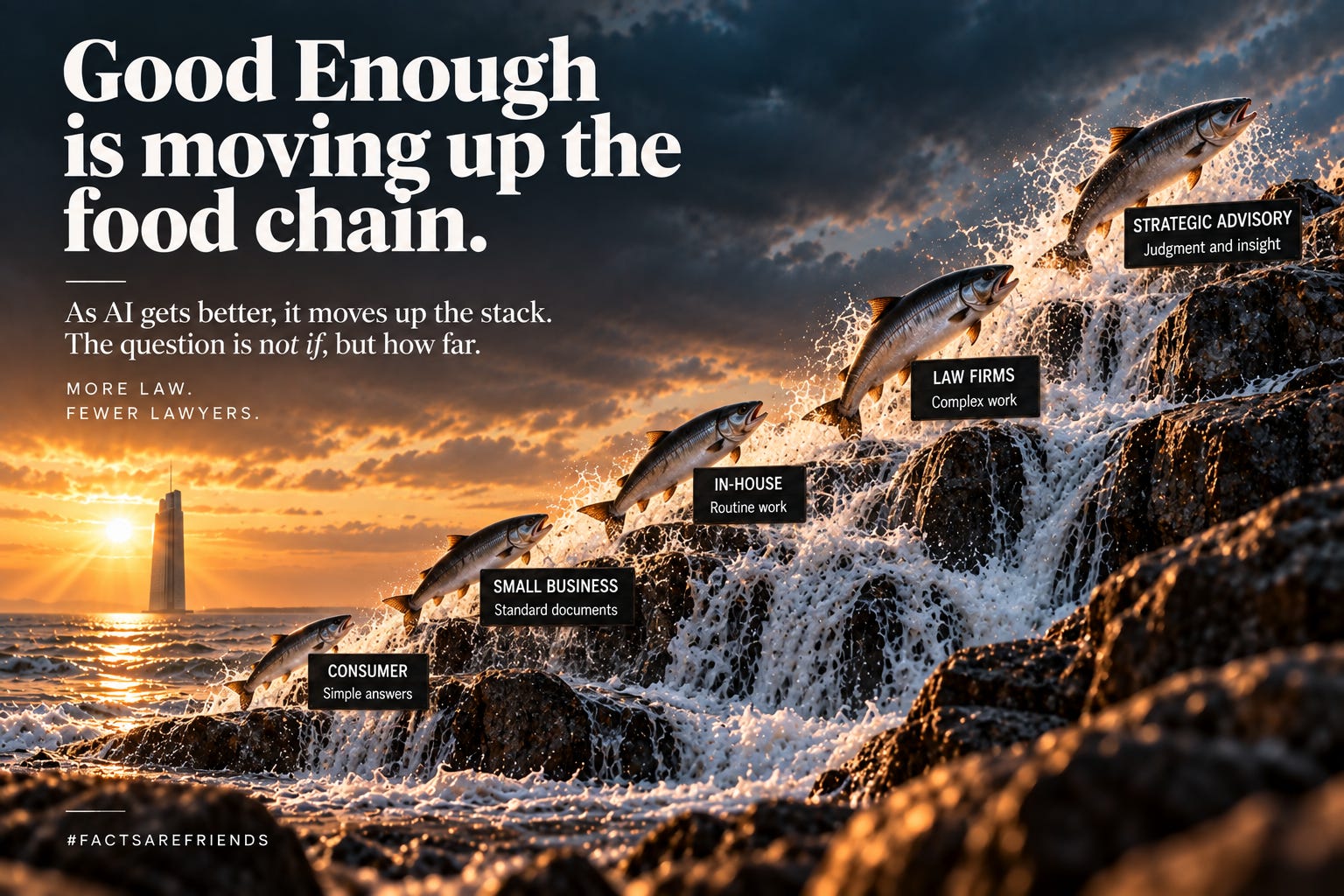
Good Enough is moving up the food chain.
When a client’s finance team, its in-house counsel and its operating businesses already buy tokens from a foundation-model company for everything else they do, they will buy the legal advice alongside the tokens. Most people will.
The pro bono horse
Harvey has already fired the starting gun with its pro bono programme, and it is interesting to see how the programme is built.
The pro bono partners at Ashurst Perkins Coie, DLA Piper and Nelson Mullins supply the casework, the frontline relationships, the client contact and the reputational cover. Hurrah for them - doing more good for more people. Wonderful.
Harvey just supplies the agents and the engineers. Expect a run of admiring articles about the legal AI company helping the underdog, with a law firm partner quoted in each and Harvey hovering with its happy halo over it all.
The firm keeps more pro bono capacity for the same budget and a good news story. Harvey keeps three things which last than a single story and accrue value rather than dissipate it:
Harvey develops and keeps a brand associated with justice for people who could never afford a lawyer. That is something no enterprise sales campaign could buy.
It keeps the evidence: Harvey has said it will measure the programme’s effect on outcomes and on lawyers’ capacity, and a published finding that its agents multiply a lawyer’s capacity is precisely the sales document it needs for its paying customers.
Harvey builds a foothold in high-volume casework, the segment the foundation models will contest first.
Harvey keeps something else as well high-volume casework in housing, welfare and veterans' claims is the richest possible source of operational evidence: which workflows hold up, where agents fail, what escalation looks like in practice and how legal need patterns itself across thousands of similar cases. Harvey uses no customer data to train its models. It does not need to. Evaluation data, workflow knowledge and case-pattern learning are what make a legal agent better, and the pro bono programme generates all three at scale, for free, in exactly the segment the foundation models will contest first.
Biology has a word for a relationship in which both parties benefit, and a different word for the point at which one party captures the lasting benefit while the other bears the cost. Apparently symbiotoic may be parasitic.
This is of course just my reading of the commercial logic rather than of anyone’s intention, and access to justice remains a real good. I may be reading too much in, I may be attributing motive inappropriately, and I am definitely not saying that pro bono support should be held back. But on my reading the firms are lending Harvey their oldest and most trusted asset, their public service tradition, and Harvey is riding it into a consumer market the firms themselves have never served.
The horse has come back through the gates wearing a charity ribbon. Ashurst Perkins Coie, DLA Piper and Nelson Mullins may win rosettes, but it is Harvey that will take the prize trophy cup with it. And it does so with beneficence. Actually, as I pointed out in a recent LinkedIn post, it is sheer genius.
The ribbon does another thing. Regulators, insurers and professional bodies are most willing to accept AI-assisted delivery where the alternative is no advice at all. Access to justice is where the delivery model gets normalised, where the first professional indemnity policies are written around it and where the first regulatory guidance is drafted. Comfort earned there travels. Once a delivery model is acceptable for a housing claimant, the argument that it is unacceptable for a mid-market commercial client becomes difficult to sustain, and the moat the profession relied on, the regulatory requirement for a human, migrates upward into the paid market with it. That too is a forecast, and the SRA and the insurers will decide its timing, but the direction is set by the sequence in which comfort is earned.

Give legal advice to the consumer who could not afford it anyway and then build the trust and respect and be ready to upsell that same consumer when they make the buying decision in a situation where they will pay for the advice. But that only works where the trusted brand is fighting in a market where all other things are equal. That market will not exist, because the foundational models will now sell the commodity legal advisory services as a utility alongside their tokens.
The foundation models’ advice will be 4K (Good Enough for most people most of the time), the price will be a rounding error on the existing bill and the question of whether to instruct a law firm will arise only for the 8K work. The 8K lawyers will be the exception that proves the rule. In that world Harvey may not get a look in - the market will be commodity in the foundation models’ pocket, or specialist in the lawyers who are still lawyers.
That is where the market is headed.
How the client gets from tool to substitute
Cheap intelligence on its own is a tool. Two things turn it into a substitute, and both are already visible in how large clients buy everything else.
The first is procurement. Clients will stop treating external legal advice as the default route for ordinary questions. Legal work will be bought the way cloud is bought: standardised, metered, measured against service levels and escalated to a human specialist only when the question exceeds a defined threshold. That is my forecast rather than a reported fact, but every other professional input a corporate buys has already gone this way, and general counsel report to the same finance directors who imposed it on IT. Once legal spend is routed rather than instructed, the law firm competes for the escalations and the machine takes the rest by default.
The second is insurance. The market does not need AI to be perfect. It needs AI to be Good Enough, cheaper and underwritten. The moment an insurer will write cover for AI-delivered legal work at a defined standard, the client can buy the advice, buy the protection and dispense with the human whose main remaining function was to carry the risk. That sequence runs in three steps. First the lawyer supervises the machine. Then the lawyer stops supervising and simply absorbs the liability, signing off work the machine has done. Then even that layer costs more than the premium which replaces it. I have called the middle step the Human Backstop Illusion: the lawyer’s presence reassures everyone while adding progressively less to the outcome, until the price of the reassurance exceeds its value. Insurability is what removes the backstop.
Put the two together and the client’s decision becomes arithmetic. Metered legal capability plus an insurance premium, against a partner’s hourly rate plus the same premium. For everything below the 8K threshold, the arithmetic settles it.
Jevons leaves the lawyer exposed
Lev has made a second argument which deserves more than a passing acknowledgement. As intelligence becomes cheaper, people will consume more of it.
He is right. Harvey’s 20-fold increase in token consumption is Jevons’ paradox in real time: efficiency reduces the cost of consuming a resource and total consumption rises. AI makes legal intelligence cheaper, so society will consume much more legal intelligence.
I agree.
My disagreement is over what follows. More consumption of legal intelligence and more consumption of lawyer-hours are different things, and that distinction separates Jevons’ paradox from what I have called the Consumption Paradox.
Imagine a company which currently asks its external solicitor five questions because each costs several hundred or several thousand pounds. Give that company almost free AI legal capability and it might ask fifty. Legal consumption has increased ten-fold, and the solicitor may be lucky to receive a single instruction because the AI was good enough in every other case.
More law, fewer lawyers.
Harvey’s pro bono programme is the Consumption Paradox seen from below. Harvey cites 1.4 million civil legal problems brought to US legal services organisations each year which cannot be addressed for lack of resources. Cheap Good Enough intelligence goes first to the enormous volume of legal need which has never been able to pay for a lawyer at all.
Consumption expands into territory no lawyer ever served, and the fee-paying middle of the market watches the same capability arrive at a price it cannot match.
Good Enough becomes an economic routing system
Tenet needs to be sufficiently good at the work for which an expensive frontier model adds too little additional value to justify the additional cost. Harvey has published no statement that every task is routed on that basis, so what follows is an economic inference, but the logic is compelling.
Use inexpensive specialist intelligence where it is Good Enough, escalate where additional capability justifies additional cost and reserve the most expensive intelligence for the cases where it changes the outcome. Apply the same logic one layer higher, because that is how clients will buy legal services.
A routine problem is Good Enough for AI alone.
A more difficult problem is Good Enough for AI plus the client’s internal team.
A high-risk problem brings in the external specialist.
Good Enough is a demand-side decision.
The client sets the threshold, and the threshold moves every time the technology improves.
The continuing need for excellent human lawyers at the difficult edge becomes evidence of how much work outside that edge no longer needs them.
Why the pyramid is vulnerable
Premium lawyers may remain extremely valuable (at least for some time), and some may become more valuable. The difficult negotiation, the novel problem, the crisis and the high-consequence judgement may still justify the best human expertise available. I emphasise “may” and deliberately do not bracket this by time.
Today’s premium lawyer arrived, though, through a pyramid supported by large quantities of less exceptional work.
Junior lawyers review documents, prepare drafts, research questions and perform the repetitions through which judgement develops, and that routine and mid-level work supports both the economics of the firm and the development of the people who eventually perform its hardest work.
AI attacks exactly that layer first.
So premium advice survives the disappearance of scarcity in routine work, at least for a time, while the pyramid beneath it becomes thinner.
Judgement preserves some lawyers. The pyramid depends on the work judgement is now replacing.
Perhaps the valuation was telling us the answer all along
The original Built on Sand argument asked why legal AI businesses were receiving valuations which appeared enormous relative to the legal software market they served, and suggested investors were looking past that market to the vastly larger legal-services market.
Harvey’s $550 million raise this month at a $15.5 billion valuation, to help legal teams “build and own their intelligence at scale”, supports that reading. The legal AI race started with the chatbot, moved into workflow and is now moving into the underlying intelligence.
The prize is the work itself.
That produces an uncomfortable inversion of my original argument.
The more rational Harvey’s valuation becomes, the more seriously law firms should take the Trojan Horse.
A weak Harvey justifies scepticism about Harvey.
A strong Harvey justifies scrutiny of the firms whose work it is increasingly capable of performing.
And a foundation-model company deciding to perform that work itself justifies scrutiny of both.
So was Built on Sand wrong?
Partly, or more accurately the position has developed.
Harvey has demonstrated that the application layer can build defensibility around substitutable models, and Lev deserves that point.
Two propositions were too easily conflated in the original debate:
Harvey may be vulnerable.
Law firms may be vulnerable.
The first has become less true against other application companies at exactly the moment the second has become more true, and both remain fully true against the companies which own the 8K intelligence and are now walking downstairs.
There is a third - and that is the point I made last year: Harvey and its ilk may be squeezed out by the foundational models going direct to consumer (private or enterprise). In that scenario, only the foundational model and the most valuable lawyers flourish (and the longevity of most of even those lawyers cannot be guaranteed as the models get better and the legal paradigm shifts).
Harvey has learnt a lesson
Harvey encountered dependency and responded with agency.
It diversified, invested, built, reduced the cost of the intelligence it consumed and moved towards control of the layer in which its future differentiation lies.
That is exactly the behaviour Lev says lawyers should display, and Kirkland is displaying it.
Perhaps there is more common ground between us than first appears.
The remaining disagreement concerns urgency and scale.
Law firms still talk about AI largely in terms of adoption: how many licences, which platform, how many hours saved.
The strategic questions are different.
What does the client now do without us?
Which parts of our knowledge and workflow remain ours?
Which supplier could we replace tomorrow?
What happens when the client can buy the advice with the tokens?
Harvey has learnt the lesson.
Its customers now have to decide whether they will, because the margin problem has moved up the chain and the lawyers are next.
What the price war does to these conclusions
The introduction promised three consequences of Tuesday’s price cuts. Here they are.
First, dependency is confirmed in both directions. Harvey moved to open-weight because the rent was too high. The landlord then halved the rent on the floor Harvey was leaving and left the penthouse at full price. Some of the margin Harvey recovered would have been recovered anyway, at the labs’ discretion, and can be removed at the same discretion. A business whose economics are set by somebody else’s pricing decision is dependent whether that decision goes for it or against it. That was the original Built on Sand argument, and Tuesday made it for me.
Second, the case for owning a model has narrowed to control. A 4K model now costs a tenth of a cent per thousand tokens from the people who make the 8K sets. Nobody hosting their own can beat that on price. What ownership still buys is the right to run, price, modify and replace the model without reference to anyone, and to keep the data that flows through it. That is the only part of Harvey’s concrete which sets, and it is the only honest rationale for Kirkland’s $500 million. Sovereignty is worth paying for. Cost savings are a gift the landlord can reclaim.
Third, the client gets there sooner. The companies which make the 8K sets now sell 4K at commodity prices, and every corporate client already has an account with them. The advice will arrive alongside the tokens, the price will be a rounding error and the question of instructing a law firm will arise only for the 8K work. I expected that to take years. Tuesday’s rate cards suggest it is a matter of quarters.
The margin problem has moved up the chain, the fare has just been cut for everyone travelling in that direction, and the lawyers are next.
Lev, over to you…
Lev, you have argued throughout this debate that lawyers retain the agency to shape what happens to them, that the profession has adapted before and will adapt again, and that platforms such as Harvey and Legora are developing into durable businesses.
Harvey has just given us the clearest example yet of what that agency looks like when dependency becomes economically uncomfortable, and Kirkland has given us the law-firm version.
On that, I suspect we now agree. There is one wrinkle in the agency argument. The pro bono partners at Ashurst Perkins Coie, DLA Piper and Nelson Mullins have exercised agency too. They chose to lend Harvey their firms' oldest and most trusted asset, their public service tradition, and Harvey is riding it into a consumer market those firms have never served. Agency is real. It cuts both ways, and the firms which exercise it most enthusiastically may be the ones handing over the most. So I am interested in the next step.
If Harvey was right to protect itself from becoming middleware between the foundation-model companies and its customers, and if those companies are now selling legal capability directly, what should a law firm without Kirkland’s $500 million do to avoid becoming middleware between the intelligence and its clients, and how does it tell the difference between exercising agency and lending its brand to somebody else's strategy? And what does a firm sell once the client can buy the advice, the insurance and the regulatory comfort without it?
The floor is yours.
Exploring how AI reshapes society, work, politics and human connection - from my forthcoming book.
#FactsAreFriends #TrojanHorseDebate
Primary reporting
Bloomberg, 21 September 2026, “Startups Like Harvey Embrace Open Models to Cut Reliance on Anthropic, OpenAI” - margin figures, token growth, Uber, Cursor and the Anthropic investor slide - https://www.bloomberg.com/news/articles/2026-09-21/startups-like-harvey-embrace-open-models-to-cut-reliance-on-anthropic-openai
Artificial Lawyer, 22 September 2026, “Harvey Launches Pro Bono Program” - https://www.artificiallawyer.com/2026/09/22/harvey-launches-pro-bono-program/
Decrypt, 22 September 2026, “OpenAI Launches GPT-6 Sol and Luna Minutes After Anthropic Drops Claude Opus 5.5”: https://decrypt.co/378986/openai-launches-gpt-6-sol-luna-anthropic-claude-opus-5-5
Kingy AI, pricing rate cards for Opus 5.5, Astra, Sol and Luna: https://kingy.ai/blog/claude-opus-5-5-vs-gpt-6-astra-vs-gpt-5-6-sol/
Harvey’s own statements
Harvey, 20 August 2026, “Harvey Tenet Research Preview” - https://www.harvey.ai/blog/post-training-update-harvey-tenet
Harvey, 9 September 2026, “Harvey Raises $550M at a $15.5B Valuation to Help Legal Teams Own Their Intelligence” - https://www.harvey.ai/blog/harvey-raises-dollar550m-at-a-dollar155b-valuation-to-help-legal-teams-own-their-intelligence
Harvey, “Introducing Harvey’s Responsible Business Program” - the programme of which the pro bono initiative forms part - https://www.harvey.ai/blog/introducing-harveys-responsible-business-program
Fireworks AI, “Post-training Kimi K3 with Harvey for long-horizon legal work” - benchmark and cost-per-task figures - https://fireworks.ai/blog/post-training-kimi-k3-with-harvey-for-long-horizon-legal-work
Law firms building their own
Financial Times, May 2026, “Kirkland & Ellis sets aside $500mn to build its own AI platform”, republished by Kirkland & Ellis - source of the Jon Ballis quotations - https://www.kirkland.com/-/media/news/press-mention/2026/05/mnl185_finallocked.pdf?rev=f9368ccf7f434cc1a32af11026a7ee44
Reuters, 28 May 2026, “Law firm Kirkland to spend $500 million developing its own AI platform” - https://finance.yahoo.com/sectors/technology/articles/law-firm-kirkland-spend-500-215908453.html
Artificial Lawyer, 1 June 2026, “Kirkland Hints It Could Fine-Tune LLMs For Own Legal AI Model” - the on-premise GPU recruitment - https://www.artificiallawyer.com/2026/06/01/kirkland-hints-it-could-fine-tune-llms-for-own-legal-ai-model/
The Global Legal Post, 29 May 2026, “Kirkland to invest $500m building own AI platform” - Clifford Chance and White & Case in-house platforms - https://www.globallegalpost.com/news/kirkland-to-invest-500m-building-own-ai-platform-1127977491
Resultsense, 3 September 2026, “Why elite law firms are building their own legal AI” - summary of Financial Times reporting: the fifth-of-large-firms figure, Hogan Lovells’ Eltemate and the Freshfields tools-for-resale point - https://www.resultsense.com/news/2026-09-03-law-firms-build-own-legal-ai/
Foundation models moving into legal
Business Wire, 23 April 2026, “Freshfields and Anthropic Team Up to Co-Build AI Legal Workflows, Deploying Claude Across the Firm Globally” - https://www.businesswire.com/news/home/20260423837690/en/Freshfields-and-Anthropic-Team-Up-to-Co-Build-AI-Legal-Workflows-Deploying-Claude-Across-the-Firm-Globally
Earlier writing in this debate
Quentin Solt, LinkedIn, 22 September 2026, “This is sheer genius from Harvey” - https://link.factsarefriends.com/10FLY
Some of the LinkedIn debate articles:
https://link.factsarefriends.com/-iKW
https://link.factsarefriends.com/-iIu
https://link.factsarefriends.com/-iGO
https://link.factsarefriends.com/-iGM
https://link.factsarefriends.com/-iFs
https://link.factsarefriends.com/-iE_
The margin collapse at Harvey isn't an operational hiccup. It's the thermodynamic reality of software catching up with linear inference costs. 📉
For thirty years, enterprise software ran on a glorious mathematical cheat. Write code once, distribute it infinitely, and let the marginal cost of compute round down to zero. Generative tokens violently broke that calculus. When an enterprise legal client expands usage twenty-fold, they aren't clicking a database index. They're forcing millions of quadratic matrix multiplications across high-wattage accelerator clusters.
If you rent those FLOPs from an upstream landlord who controls the pricing schedule, your gross margins don't scale. They invert. Harvey swinging from positive 50% to negative 50% gross margin is the cleanest empirical proof we've seen: probabilistic generation without strict execution gating is a financial hemorrhage. 🩸
Moving to an open-weight foundation like Tenet is the obvious defensive reflex. Yet notice the structural trap. The moment an application company spends millions fine-tuning open weights to escape the landlord's meter, the landlord simply slashes the commodity floor. Dropping GPT-6 Luna to pennies per million tokens isn't charity. It's predatory pricing engineered to pull the economic rug out from under private fine-tunes.
Here is the core truth. The entire legal tech debate misses where value actually settles. Legal counsel isn't a text generation problem. It's a deterministic state-transition problem.
Clients don't pay a law firm for thousands of fluent tokens. They pay for the non-delegable absorption of catastrophic risk. The real moat isn't whether your model is 4K or 8K. The moat is whether an insurer will underwrite the output when the transaction crashes. When an autoregressive engine hallucinates a cross-default trigger, the client doesn't care that the prompt was elegant. They care who pays for the wreckage. ⚖️
This reveals an inescapable architectural law. True defensibility in high-liability verticals won't belong to the wrapper that drafts the memo, nor to the cloud landlord who burns the coal to emit it. It crystallizes exclusively inside the deterministic verification gate that proves statutory compliance and absorbs legal liability before commit.
Kirkland spending $500 million on internal infrastructure marks the beginning of this bifurcation. Elite firms will own their private weights to maintain client privilege and run local verification kernels. Meanwhile, mid-market commodity drafting gets absorbed directly into the foundation model's base subscription.
The middle tier of legal middleware gets squeezed from both sides. Above, the landlords sell commodity drafting alongside base tokens. Below, elite firms turn their proprietary precedent into non-exportable hardware enclaves.
If the entire routine document stack becomes a commodity token utility, what single asset does an outside firm actually hold that an insurer can't price directly off the landlord's API? 🏛️
(⌐■_■)b